


2.6.0 (mosga.py)

Job 195325c3 - Saccharomyces strains

Status
Finished
Finished at
2021/06/07 18:04
Finished in
1 h 51 min

Comparative Genomics results

Your prediction results are ready and at least available until 2021/13/07 18:04.

Click on a button to receive the related results.


BUSCO
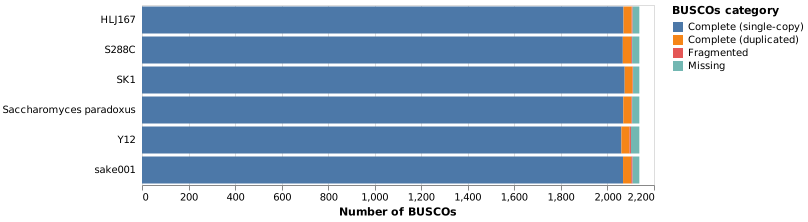
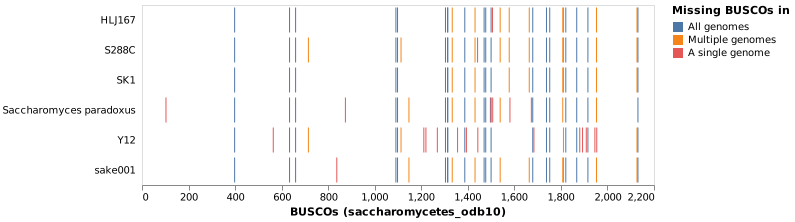
Completeness (HTML) Missing (HTML)
Completeness
Missing BUSCOs


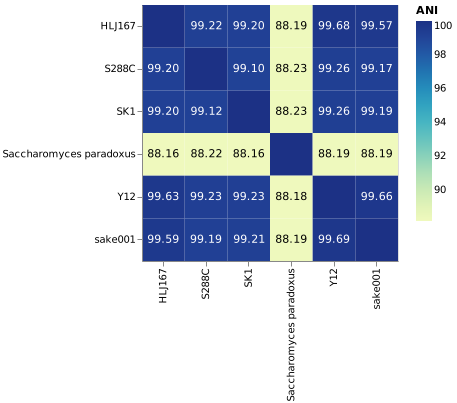
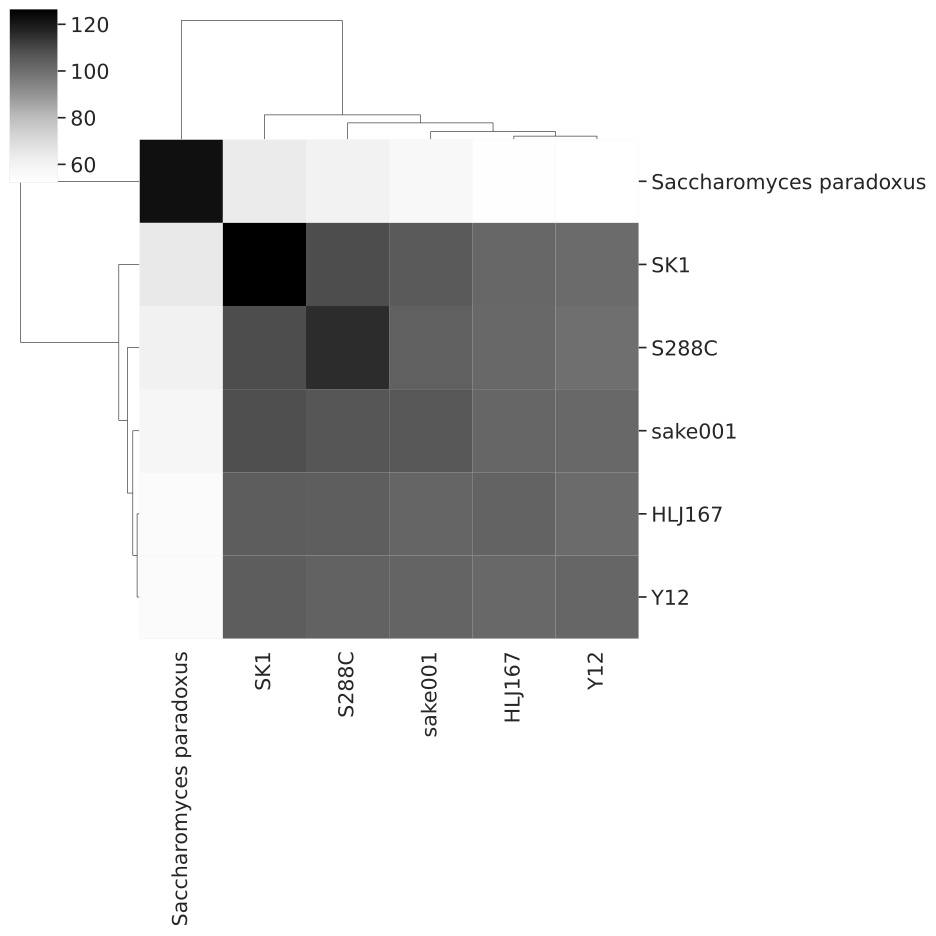
ANI
Raw file Visual file Heatmap (HTML)

Query genomeReference genomeANI valueBidirectional fragmentsTotal fragments
Saccharomyces paradoxusY1288.184435314023
Saccharomyces paradoxusSK188.228336564023
Saccharomyces paradoxussake00188.189636594023
Saccharomyces paradoxusS288C88.231537004023
Saccharomyces paradoxusHLJ16788.194236374023
Y12Saccharomyces paradoxus88.191335393709
Y12SK199.25936833709
Y12sake00199.687636853709
Y12S288C99.262136853709
Y12HLJ16799.68436863709
SK1Saccharomyces paradoxus88.157737124040
SK1Y1299.228736784040
SK1sake00199.209738114040
SK1S288C99.099338684040
SK1HLJ16799.199437954040
sake001Saccharomyces paradoxus88.186436483918
sake001Y1299.659536823918
sake001SK199.192238163918
sake001S288C99.169738213918
sake001HLJ16799.570737953918
S288CSaccharomyces paradoxus88.222537054045
S288CY1299.228636794045
S288CSK199.117338644045
S288Csake00199.189938074045
S288CHLJ16799.217838044045
HLJ167Saccharomyces paradoxus88.163436393850
HLJ167Y1299.633936853850
HLJ167SK199.201138053850
HLJ167sake00199.585337873850
HLJ167S288C99.199738013850


Table file

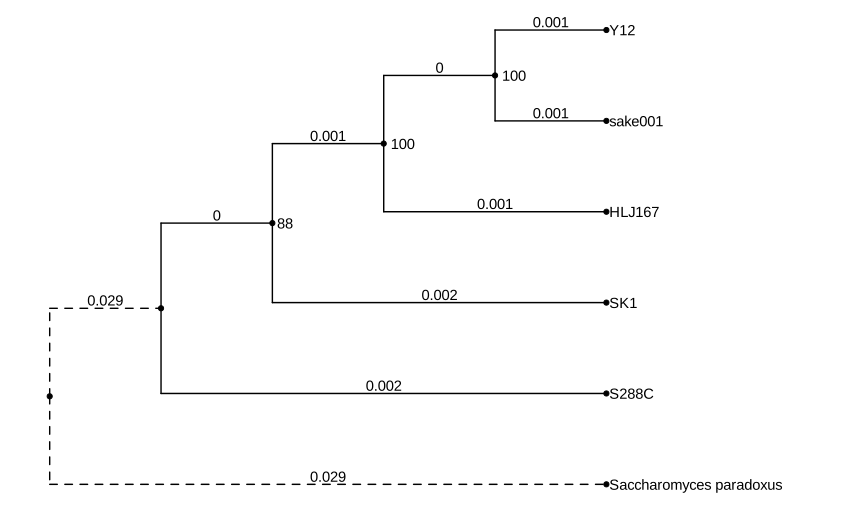
Genomes HLJ167 Y12 sake001 S288C Saccharomyces paradoxus SK1
HLJ167 103.13 100.81 102.45 104.42 55.1 104.87
Y12 101.61 102.02 102.59 103.32 54.66 104.61
sake001 102.1 101.49 106.2 106.54 58.25 108.43
S288C 101.47 99.65 103.89 115.5 60.82 108.86
Saccharomyces paradoxus 53.07 52.27 56.33 60.19 122.0 63.66
SK1 101.8 100.76 105.54 108.66 64.14 126.28


Please cite always:

  • Roman Martin, Thomas Hackl, Georges Hattab, Matthias G Fischer, Dominik Heider (2020). MOSGA: Modular Open-Source Genome Annotator. Bioinformatics. 36(22-23). 5514–5515. doi: 10.1093/bioinformatics/btaa1003.
  • Roman Martin, Hagen Dreßler, Georges Hattab, Thomas Hackl, Matthias G Fischer, Dominik Heider (2021). MOSGA 2: Comparative genomics and validation tools. Computational and Structural Biotechnology Journal. 19. 5504-5509. doi: 10.1016/j.csbj.2021.09.024.

Do you have some questions, issues or just would like to give us feedback? Please don't hesitate to write us or feel free to open a new issue on Gitlab.

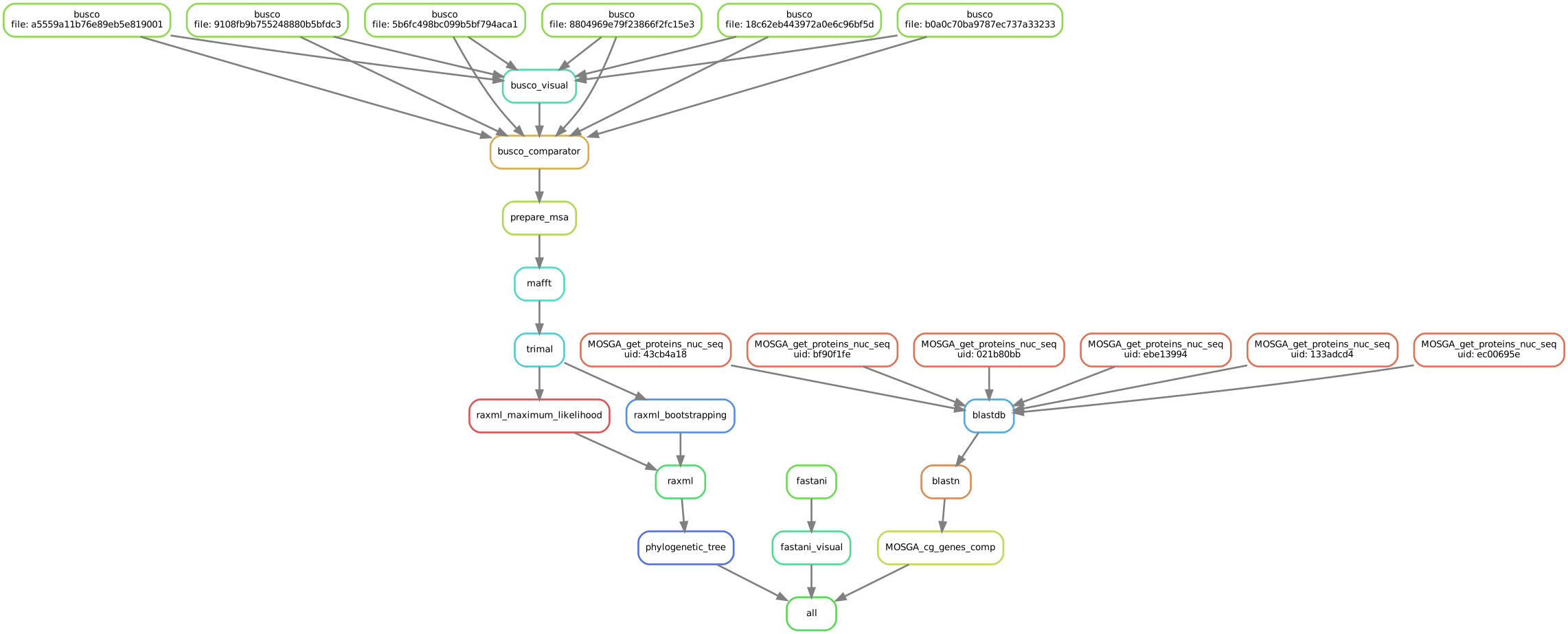
Snakemake configuration Snakemake log What to cite

Single outputs
BUSCO genes BUSCOs category (HTML) BUSCOs missing (HTML) FastANI results FastANI visual file FastANI values (HTML) GC results GC Similarity SVG trimAl output MAFFT output

What to cite
Capella-Gutiérrez S, Silla-Martínez JM, Gabaldón T. trimAl: a tool for automated alignment trimming in large-scale phylogenetic analyses. Bioinformatics. 2009 1;25(15):1972-3. doi: 10.1093/bioinformatics/btp348.
Yu G, Smith D, Zhu H, Guan Y, Lam T T. ggtree: an R package for visualization and annotation of phylogenetic trees with their covariates and other associated data (2017). Methods in Ecology and Evolution, 8(1):28-36. doi:10.1111/2041-210X.12628
Katoh K, Standley DM. MAFFT multiple sequence alignment software version 7: improvements in performance and usability. Mol Biol Evol. 2013 ;30(4):772-80. doi: 10.1093/molbev/mst010.
Jain C, Rodriguez-R LM, Phillippy AM, Konstantinidis KT, Aluru S. High throughput ANI analysis of 90K prokaryotic genomes reveals clear species boundaries. Nat Commun. 2018 30;9(1):5114. doi: 10.1038/s41467-018-07641-9.
Waterhouse RM, Seppey M, Simão FA, Manni M, Ioannidis P, Klioutchnikov G, Kriventseva EV, Zdobnov EM. BUSCO Applications from Quality Assessments to Gene Prediction and Phylogenomics. Mol Biol Evol. 2018 1;35(3):543-548. doi: 10.1093/molbev/msx319.
Stamatakis A. RAxML version 8: a tool for phylogenetic analysis and post-analysis of large phylogenies. Bioinformatics. 2014 1;30(9):1312-3. doi: 10.1093/bioinformatics/btu033.
Katoh K, Misawa K, Kuma K, Miyata T. MAFFT: a novel method for rapid multiple sequence alignment based on fast Fourier transform. Nucleic Acids Res. 2002 15;30(14):3059-66. doi: 10.1093/nar/gkf436.
Martin R, Hackl T, Hattab G, Fischer MG, Heider D. MOSGA: Modular Open-Source Genome Annotator. Bioinformatics. 2021;36(22-23):5514-5515. doi: 10.1093/bioinformatics/btaa1003
Simão FA, Waterhouse RM, Ioannidis P, Kriventseva EV, Zdobnov EM. BUSCO: assessing genome assembly and annotation completeness with single-copy orthologs. Bioinformatics. 2015 1;31(19):3210-2. doi: 10.1093/bioinformatics/btv351.
Stamatakis A. RAxML-VI-HPC: maximum likelihood-based phylogenetic analyses with thousands of taxa and mixed models. Bioinformatics. 2006 1;22(21):2688-90. doi: 10.1093/bioinformatics/btl446.

Upload your assembled FASTA eukaryotic genome file.

Needed for the GenBank/ENA submission files.
Assembly details for the submission (optional): GenBank needs all three as structured comment, ENA in the Webin-CLI manifest. MOSGA adds the annotation details itself.
Priority (highest priority first)
    Overlapping features
    How overlaps of these types are solved, only types of the selected tools are listed. Removed features are listed with the reason in removed.gff of the results. Overlapping rRNAs are always solved (table2asn rejects them).

    CpG island detection


    CpG island detection


    Splicing site detection


    Functional Enrichment Analysis


    Protein-Protein Interactions Analysis


    Protein-Protein Interactions Analysis


    Choose your tools:

    Genes

    Gene
    Protein-coding genes

    Prediction of gene locations and splice sites.

    Mode of work

    Evidence-based or ab initio prediction.

    Functional Annotation

    Functional gene prediction.

    Repeats

    Repeats

    Detection of repeating sequences.

    tRNAs

    tRNA

    Prediction of tRNA sequences.

    rRNAs

    rRNA

    Search for rRNA sequence matches.

    ncRNAs

    ncRNA

    Search for non-coding RNA genes.

    Telomeres

    Telomere

    Detection of telomeric repeats.

    Assembly Validation

    Genome Completeness

    Validate genome completeness.

    Annotation Statistics

    Statistics of the final annotation.

    Quality-Control

    Contamination detection.


    UID Name Files Submission Date Start date End date Mode Status

    The Modular Open-Source Genome Annotator (MOSGA) is a pipeline that easily creates draft genome annotation by a graphical user interface. It combines several specific prediction tools and generates a submission-ready annotation file.

    The source code is freely available on Gitlab.com or Zenodo.com (DOI: 10.5281/zenodo.5121228). We recommend building a new docker container from the available Dockerfile in the linked Gitlab repository. MOSGA is written modular and allows easy integration of new prediction tools or even including whole third-party pipelines.

    No command line

    Upload a genome, choose the tools with a click and follow the job in the browser.

    Submission-ready

    NCBI .sqn/.tbl and ENA EMBL with Webin manifest, a submission check tells what to fix.

    Modular tools

    Genes, repeats, tRNAs, rRNAs, ncRNAs and telomeres, freely combined from established predictors.

    Conflict resolution

    Overlaps are solved by type and tool priority, removed features are listed with the reason.

    Functional annotation

    Product names from Swiss-Prot, eggNOG and IDTAXA, names to review are flagged.

    Quality control

    BUSCO, EukCC, AGAT, BlobTools and VecScreen in the same job.

    Comparative genomics

    ANI, gene comparison, phylogenetic trees and completeness across genomes, also of earlier jobs.

    Organelle scan

    Finds likely mitochondrial and plastid scaffolds and suggests to submit them as organelle sequences.

    Interactive results

    JBrowse 2 genome browser, summaries and all files on one results page.

    One Docker image

    Pinned and checksum-verified tool versions for reproducible results, self-hosted so the data stays in-house.

    Convenient workflow

    Uploads of several GB in resumable parts, profiles per kind of job, "Submit again", retry of failed jobs and mail notification.

    Open source

    MIT licensed, the code is on GitLab and Zenodo, new tools and merge requests are welcome.

    For any questions or comments, please contact us: roman.martin@uni-marburg.de. We are happy to receive new suggestions or even merge requests for a pipeline extension. To provide an overview of the operation principle, we recommend reading our Gitlab wiki page.

    We are providing an example data set of the draft genome annotation of Cafeteria roenbergensis BVI strain. Initially, we used an early version of MOSGA to annotate this genome (Hackl et al., 2020). Hackl, T., Martin, R., Barenhoff, K. et al. Four high-quality draft genome assemblies of the marine heterotrophic nanoflagellate Cafeteria roenbergensis. Sci Data 7, 29 (2020).

    We provide two examples for the comparative genomics workflow: The Saccharomyces species phylogenetics and the Saccharomyces gene comparison. An exemplary annotation job for the organelle scanner based on the Nannochloropsis oceanica genome is here available.

    Please take care about the licenses of the selected tools.

    Whenever you use MOSGA please cite us:
    Roman Martin orcid, Thomas Hackl orcid, Georges Hattab orcid, Matthias Fischer orcid, Dominik Heider orcid (2020). MOSGA: Modular Open-Source Genome Annotator. Bioinformatics. 36(22-23). 5514–5515. doi: 10.1093/bioinformatics/btaa1003.

    Roman Martin orcid, Hagen Dreßler orcid, Georges Hattab orcid, Thomas Hackl orcid, Matthias Fischer orcid, Dominik Heider orcid (2021). MOSGA 2: Comparative genomics and validation tools. Computational and Structural Biotechnology Journal. 19. 5504-5509. doi: 10.1016/j.csbj.2021.09.024.

    The University of Münster hosts this MOSGA instance for demonstration purposes.
    It runs on a virtualized AMD Ryzen CPU with 8 cores and 32 GB of memory.

    We keep the 100 most recent job submissions online. Once this limit is exceeded, we delete the oldest job that is more than 14 days old. Incoming jobs are queued and processed as soon as possible. Jobs that occupy our hardware for more than 48 hours may be terminated. We recommend not uploading files larger than 2 GiB.

    We reserve the right to analyze failed jobs in order to identify errors and to provide bug fixes and quality improvements. Even so, your results will not be shared with anyone and will be deleted regularly.

    If you provide a notification email address, we may contact you if your job fails so that we can help resolve the issue.

    Imprint

    Universität Münster
    Medizinische Fakultät (Faculty of Medicine)
    Albert-Schweitzer-Campus 1, Building D3
    48149 Münster, Germany
    Phone: +49 251 83 52263
    Fax: +49 251 83 55004
    Email: dekanmed@ukmuenster.de

    The Faculty of Medicine is part of the University of Münster. The University of Münster is a corporation under public law (Körperschaft des öffentlichen Rechts) and also an institution of the State of North Rhine-Westphalia. It is represented by its Rector, Prof. Dr. Susanne Menzel-Riedl.

    Supervisory authority:
    Ministerium für Kultur und Wissenschaft des Landes Nordrhein-Westfalen
    Völklinger Straße 49
    40221 Düsseldorf, Germany

    VAT ID: DE 126118759

    Responsible for content pursuant to § 18 (2) MStV:
    The Dean of the Faculty of Medicine
    Prof. Dr. Frank Ulrich Müller
    Albert-Schweitzer-Campus 1, Building D3
    48149 Münster, Germany
    Phone: +49 251 83 52263
    Fax: +49 251 83 55004
    Email: dekanmed@ukmuenster.de


    Server usage